
Basement remodeling is one of the most effective ways to increase your home’s usable square footage. For many homeowners, the basement is a nearly blank canvas, providing an opportunity to upgrade the space in a way that best serves their specific needs.
When considering these projects, it’s common for people to want to know what a basement typically costs to renovate. It’s natural to want to know what to expect for the total cost, so in this post, I’ll take a deeper look at the budgetary side of basement upgrades to help you set realistic expectations.
The truth is that there’s no standard or average basement remodel. Every project has unique elements that drive the cost, ranging from the size and condition of the existing basement to the scope, complexity, and materials of the finished space.
That said, I’ll draw on our remodeling experience to give some hard numbers and a deeper explanation about what influences the overall project cost.
What Does a Basement Remodeling Project Cost?
In the Ithaca area and Upstate New York, a low-level basement remodel starts at around $40,000. This type of project is primarily focused on simply finishing basement walls, putting in basic flooring (such as vinyl flooring), and doing some light work on an exposed ceiling. At this price point, your basement becomes a finished space that’s more usable. But it’s not especially polished, and it’s certainly not customized for specific uses.
On the high end, full basement finishing costs are around $225,000, and those costs can get higher if the basement is especially large or if you opt for all of the highest-end materials and finishes.
Obviously, there’s a big middle range between $40,000 and $225,000. In the next sections, I’ll review the factors that shape a project’s cost within that range.
What Factors Drive the Cost of Basement Remodeling?

As with any remodel, labor costs and material costs are the biggest cost drivers. But how much labor and how many materials are needed for a specific basement remodel depends on a range of factors that can dramatically impact the total cost.
Foundation Repairs
An unexpected cost for some basement remodels is the need for foundation repairs. Until a remodeler or inspector can take a closer look, it may not be apparent that the foundation needs work just to make a basement remodel possible. These repair and waterproofing costs make a project more expensive, but they also enhance a home’s durability and structural integrity.
Basement Size
As a general rule, a larger basement will cost more to remodel than a smaller one if all other design elements are held constant. You simply need more materials and more time for a basement with more square footage.
Finishing a Basement vs. Refinishing a Basement
Most basement remodels are basement finishing projects, which create usable space out of a neglected part of a home. But some homeowners have a partially finished basement that they want to complete, and, in some cases, people want to refresh or upgrade an already finished basement.
Fully remodeling an unfinished basement tends to be more costly because there’s more prep work involved. That said, a “refinishing” project can also require significant material and labor expenses if we have to undo past work. For example, if the existing plumbing in a finished or partially finished basement is subpar, it doesn’t offer any cost savings relative to remodeling an unfinished basement.
Project Scope
Project scope is fundamental in determining what any basement renovation costs. The nature of the work directly influences the extent and type of design and construction work required, including electrical work, plumbing costs, and ventilation or connection to the home’s HVAC system.
As I touched on before, if the goal is to simply finish the exterior walls, install flooring, and create a bare-bones finished space, that limited scope helps keep the project cost down.
On the other end of the spectrum, a multi-room basement renovation is going to have a higher price tag, especially if those rooms have distinct uses. For instance, installing a large living area, kitchenette, and guest suite (with a bedroom and full bathroom) requires more diverse types of labor and materials. It gives you the most comprehensive end result, but it costs more to complete.
In the middle, a remodel can focus on thoroughly building out one specific basement space. Some possibilities include things like:
- Home theaters
- Home gyms or yoga studios
- Kids’ playroom or living spaces
- Laundry rooms
- Wet bars or kitchenettes
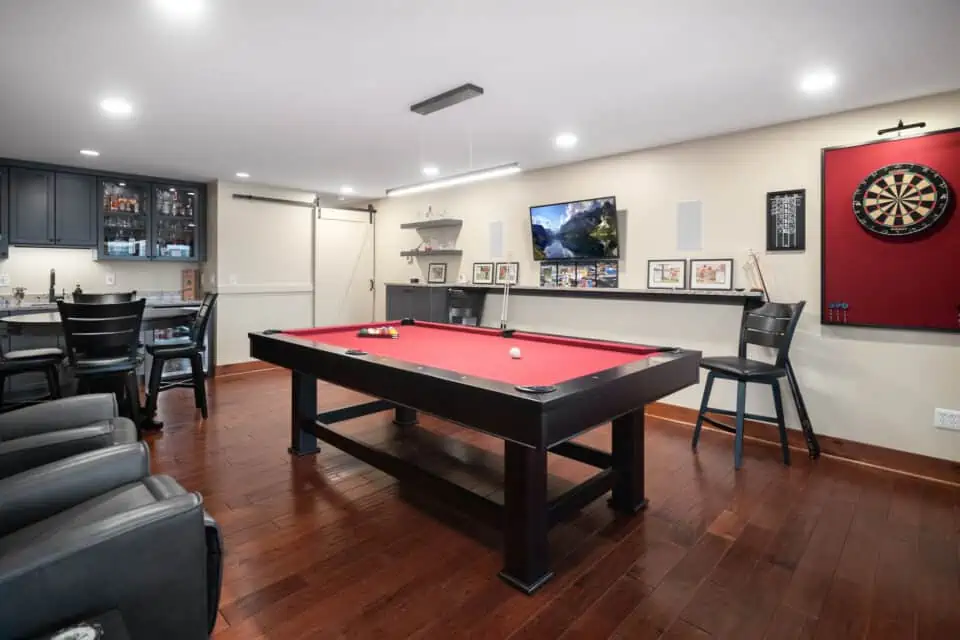
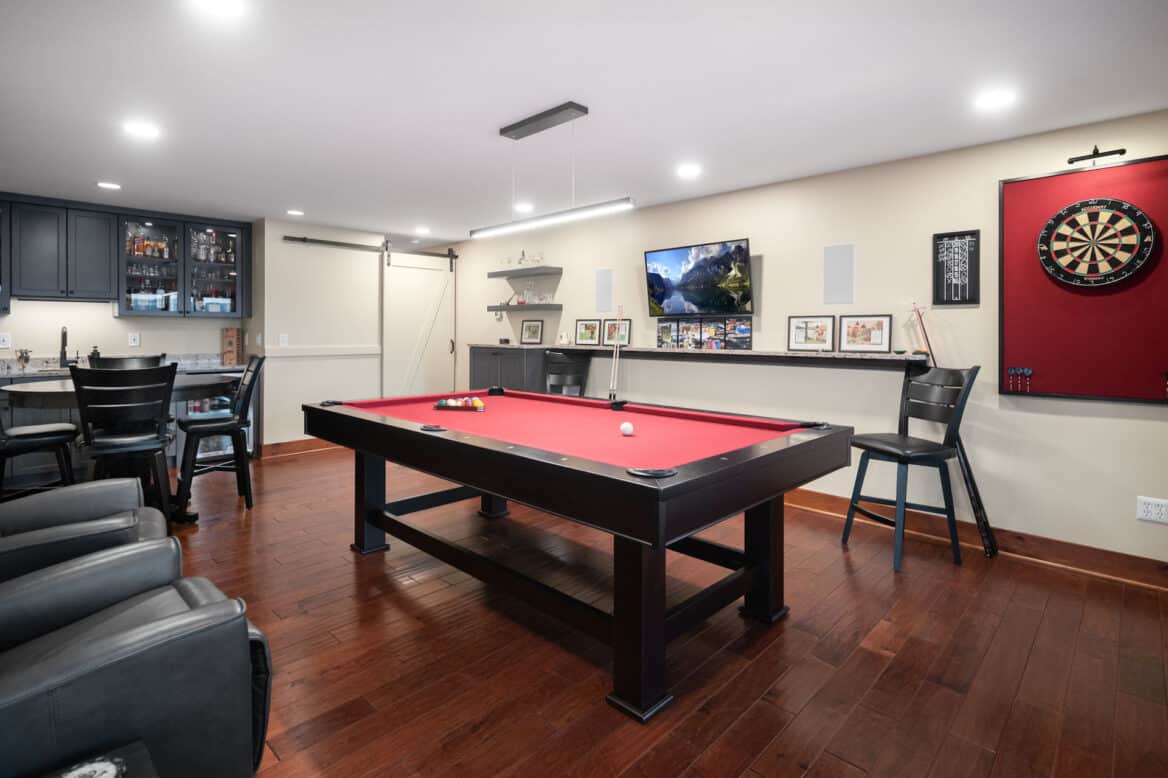
- Game rooms
- Spa retreats
- Home offices
- Music studios
- Workshops
- Expanded storage spaces
- Wine cellars
Each of these spaces has its own set of design requirements that shape the project cost, but remodeling a single space will typically be more budget-friendly than a multi-room scope.
Design Elements, Features, and Complexity
Certain design elements frequently come with higher costs. To give one often overlooked example, local building codes require an egress window for any basement bedroom. Depending on the shape and orientation of your basement, that can add cost relative to other types of remodels.
In addition, optional design features can impact project costs. Creating a daylight basement or walkout basement can be an amazing upgrade, but it may require extensive design and construction work (which itself will vary based on the slope of your lot).
As you would probably expect, more complex and feature-rich designs provide a bigger payoff, but they are more expensive projects.
Materials and Finishes
The quality and style of the materials and finishes also play a role in the total project cost. Choosing luxury finishes and materials with a higher cost per square foot, such as more expensive flooring, can push up the project’s budget. For homeowners looking to keep construction costs down, choosing cost-effective materials and finishes is a straightforward way to save money without sacrificing functionality.
The Importance of Value (and Not Just Cost)
It’s natural to get caught up in the bottom-line number. But based on our 30-plus years in this industry, I’d encourage you to think more broadly about value.
Our firm finds it most helpful to start with the intended use of the space rather than focusing solely on price. By understanding your goals, how you want to use the basement, and what you would like it to add to your home and daily life, we can guide the design and recommend the best approach for your needs.
In this way, starting with our earliest conversations about design options, we focus more on value than just price. It is relatively easy to cut costs on a project, but frequently, that means removing value faster than reducing price. Through collaboration and consultation, we work with our clients to find the right balance in terms of scope, materials, and features to maximize value and the return on investment (in terms of both property value and quality of life).
Next Steps: Planning a Basement Remodel with Upscale Remodeling
Upscale Remodeling is a design-build firm with deep roots in the Ithaca area. We’ve been in business here for more than three decades, and we take pride in offering the highest level of custom remodeling solutions to our clients.
We offer end-to-end service, including all design and construction, which allows us to offer a seamless and efficient remodeling experience. You can read more about us and our team on our website, where you can also see our portfolio of past work.
If you’re thinking about upgrading your basement, contact us today to schedule a consultation.